From 4 years · 30 minutes · £11 a lesson
Children's swimming lessons
Levels 1 to 8. Small classes, a teacher in the water, and water safety taught alongside the swimming.
Whether your child has never been in a pool or is already swimming a length, they start where they actually are — not where a register says they should be.
Two children the same age can be a year apart in the water. That's normal.
Right for
- Complete beginners
- Children who can swim a little
- Children working towards 25m
- Water safety
The classes
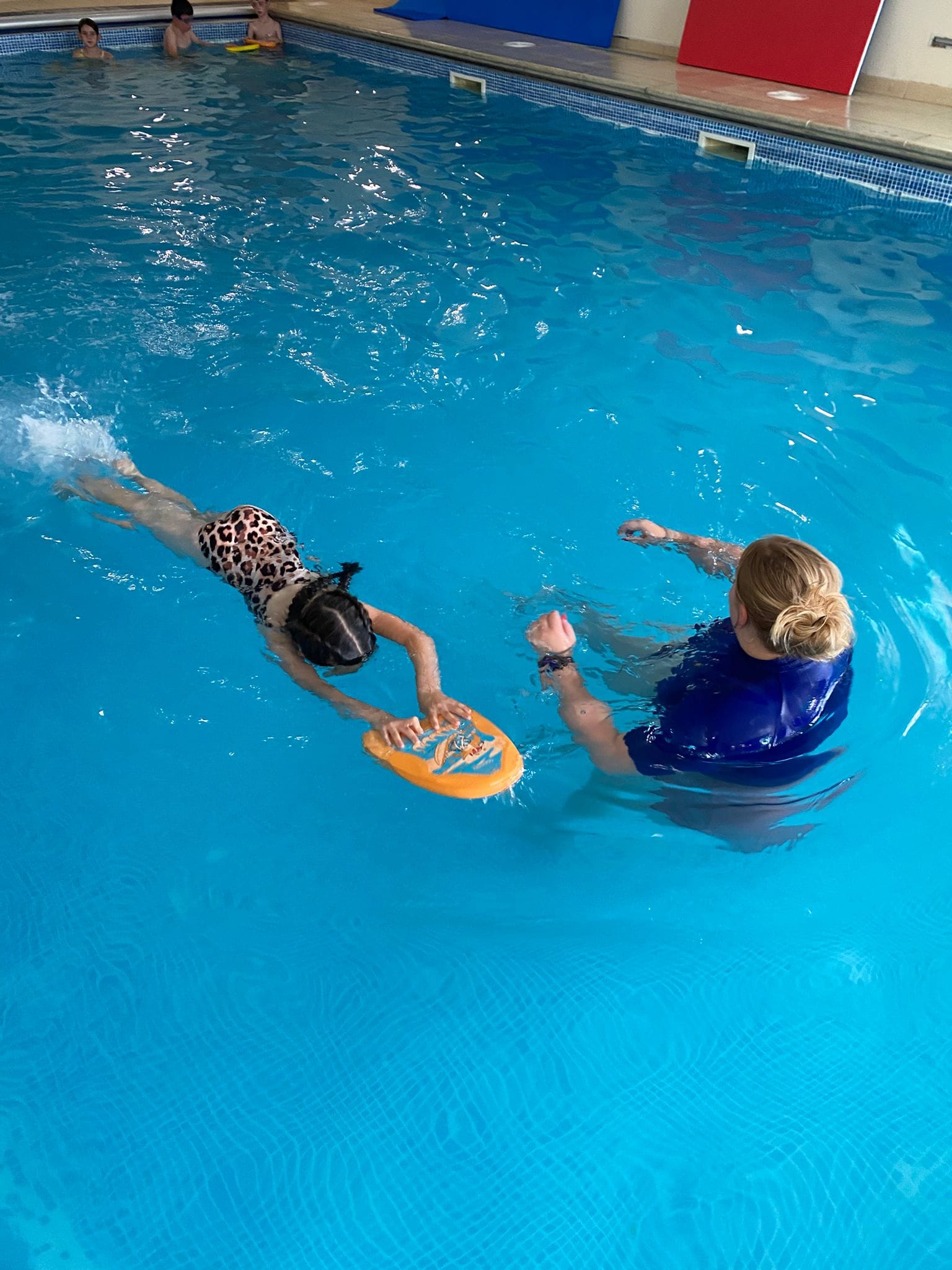
Up to six children with a teacher. If a seventh joins the class, a teaching assistant joins too — so there are two members of staff and more eyes on the pool, which means more swimming, not less.
In Levels 1 to 4 teachers work both in and out of the water, so there's always someone in there when a child needs a hand. Of an evening we put an assistant in the pool alongside the teachers wherever we can.
That's how trust gets built — from day one, at your child's height, close enough to catch a wobble before it turns into a fright.
What they actually do
Every skill gets broken right down and built back up a piece at a time. We teach a stroke whole, then take out the bit that needs work, then put it back. Body position first, then legs, then arms, then breathing, then putting it all together.
They think they're playing
- Flippers and fins
- Woggles
- Kickboards
- Pull buoys
- Hoops to swim through and go under
- Sinky toys to fetch off the bottom
- Balls and floats
It looks like messing about. A child fetching a sinky toy off the bottom thinks they're playing. They're submerging, opening their eyes and controlling their breath — which is far harder to teach by asking.
Water safety, not just swimming
We teach what being safe in water actually means, and what to do if they ever fall in and find themselves in difficulty — how to get themselves to safety.
We hope it never happens. But forewarned is forearmed.
How progress is counted
The national curriculum records swimming as pass or fail at 25 metres. That means a child who couldn't swim a stroke in September and can now manage fifteen metres on their own has, officially, achieved nothing.
We record every five metres, and every one of them gets recognised. Your child is assessed every single lesson, and you get written feedback — what they can do now, what they're working on next.
Why we don't stop at Level 5
Level 5 is where a child swims 25 metres unaided. That's the national curriculum standard, and it's where most children leave a swimming school. We'd rather they didn't.
Twenty-five metres is a length of a pool. It's a real achievement and worth celebrating. It isn't the same as being safe in water.
Children who get into difficulty in open water usually aren't children who can't swim. They're children who can't swim for long enough.
Cold water, clothes, no wall to hold, nobody within reach. The distance between where you fall in and somewhere you can get out is almost never twenty-five metres.
That's what Levels 6, 7 and 8 are for.
- Refining technique, and holding that technique over much longer distances
- Getting all four strokes to a competent standard, not just one
- Starts and turns
- Sculling and surface diving
- Old English backstroke
- Medleys
By the end they've been taught every technique a swimming club would expect — so if a child ever wants to go and swim for one, the door is open rather than shut.
A child who can swim four strokes properly, and keep going, has something different from a child who has swum twenty-five metres once.
Badges and certificates
Children collect badges for their levels, for distance and for water safety. £4 each, or £4.50 for the water safety ones, which come with their certificate.
Most children have been happy to stop once they've got the 25 metres. The badges are there to give them something to keep aiming at.
What to bring
A costume and a towel. Goggles if your child likes them.
Bring
- A swimming costume
- A towel
Nice to have
- Goggles, if your child likes them
Don't need
- Equipment — we provide floats, woggles, kickboards, pull buoys, flippers and the rest
Water does two things nothing on land can
It takes your weight
Nothing jars and nothing pounds. Joints that have started complaining about a hard floor don't complain in water. For a lot of people it's the one kind of exercise still properly open to them.
And it pushes back
Water is far harder to move through than air, so every movement meets resistance — steady, even, and from every direction at once. You don't need weights; you're already working against something.
Which is an unusual combination: something that asks a great deal of your muscles and almost nothing of your joints.
It also means you can work harder in water than you can on land. Nothing is braking you — no impact to absorb, no landing to brace for — so you can push further than your knees would ever let you push on a pavement.
It's also one of the few things that gets more useful as you get older, not less. Plenty of people come to us having given up on exercise that hurts.
If you're swim fit, you're fit for anything.
People don't learn in cold water.
A cold child isn't learning anything except that they want to get out. A cold adult is holding their breath and bracing. Warm water is the first condition for teaching anybody anything in a pool.
You step in and there's no shock, no standing on the steps working up to it, no sharp breath. Ours sits at 33 degrees. Most pools run around 28, and five degrees is the difference between bracing yourself and just getting in.
We've babies in there, children, and plenty of women well over sixty. Our teachers are in the water for hours at a time. It has to be warm.
For a nervous swimmer that matters more than anything else on this page. The first thirty seconds decide how the rest of the lesson goes.
Price
- Per lesson
- £11
- Block of 4 lessons
- £44 — Paid every four weeks
You pay in four-week blocks, not a whole term up front — every payment covers four lessons.
What it costs to join
When you join, you pay for the lessons left in the current block, plus one block of four in advance. After that it's £44 every four weeks.
A £5 assessment so we can put your child in the right level. £5 covers a full set of certificates. Pay once when you join the baby classes and you get every baby certificate. Moving up to levelled lessons is a new set, so £5 again — and that covers all eight levels.
For example, joining with two lessons left in the block:assessment £5 + certificates £5 + 2 lessons £22 + advance block £44 = £76.Join at a different point in the block and the number of lessons — and the total — changes. After your first payment it's always £44 every four weeks.
Come and watch a lesson
The quickest way to know whether a swimming school suits your child is to see one.
Ogden Hall
24 Causeway Foot, Ogden, Halifax, HX2 8YB
There's a large car park on site, and it's free. You won't be hunting for a space.
Before you book, our Parent & Carer Code of Conduct, Safeguarding & Child Protection Policy and General Terms & Conditions are all published.